
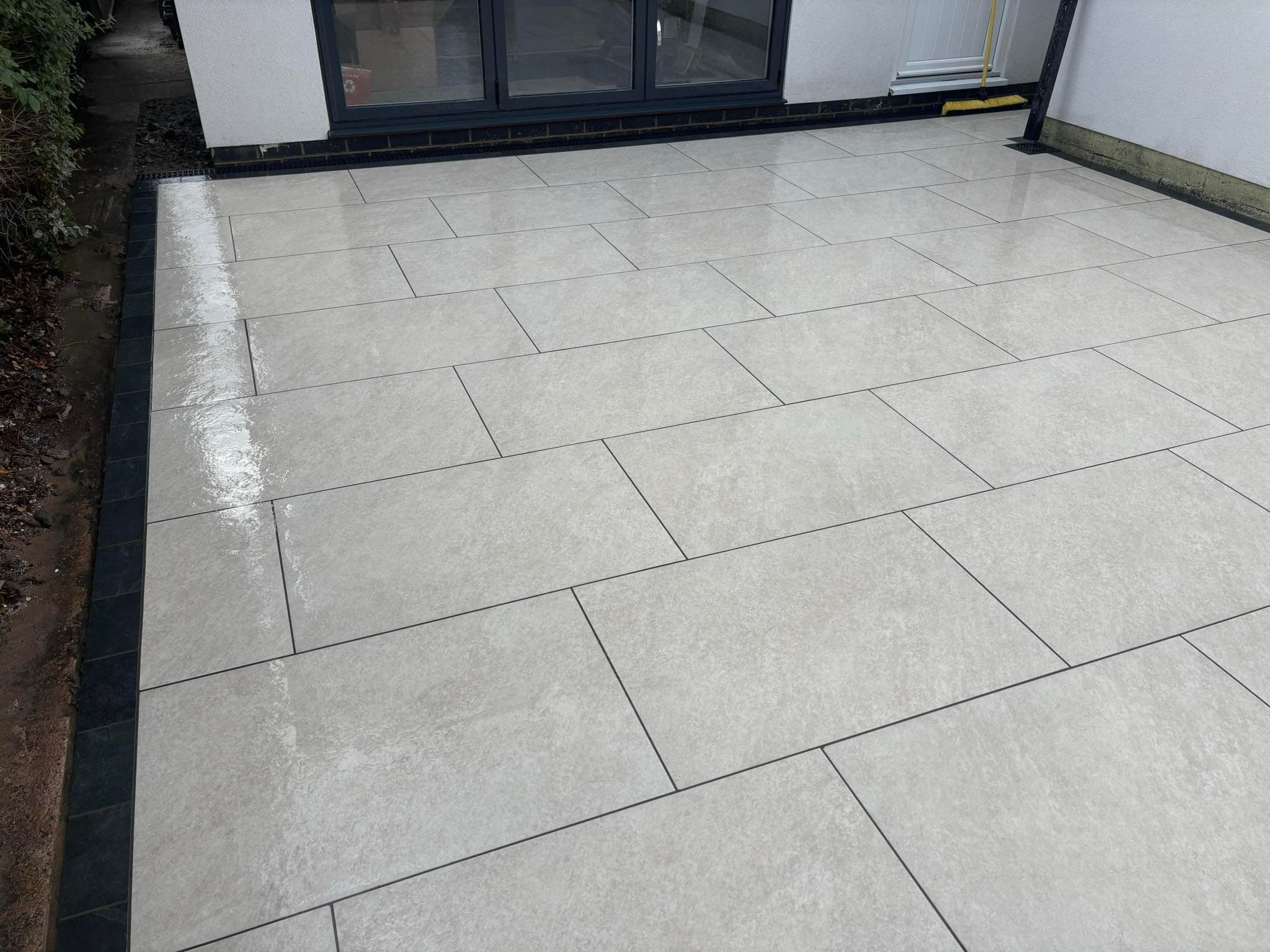
Porcelain has taken over. Look at what is going into new gardens across Derby, Mickleover, Chellaston and the newer estates, and most of it is grey porcelain rather than the sandstone that dominated a decade ago. It suits modern houses, it needs almost no upkeep, and it looks the same in year ten as it did in year one.
It is also the least forgiving material we lay. Sandstone hides a multitude of sins. Porcelain hides none of them, which is why a porcelain patio installed by someone treating it like ordinary paving looks wrong very quickly.
Here is what a proper porcelain installation actually involves, and what to ask before you accept anyone's quote.
Why porcelain is different to lay
Porcelain is fired clay, pressed and baked until it is dense and effectively non-porous. That is the whole appeal: nothing soaks in, so nothing stains, and it never needs sealing. It is also what makes it awkward to install.
Three things change compared with natural stone:
- It will not bond on its own. Mortar grips sandstone because sandstone is porous. Porcelain is not, so the back of every slab has to be primed with an SBR slurry immediately before it goes down. Skip that and the slab is sitting on the mortar rather than stuck to it, and it starts to lift or ring hollow within a season or two.
- It has to be cut wet. A disc cutter chips and blows out the edges. Clean cuts need a wet saw with a porcelain diamond blade, which is slower and messier and shows in the labour cost.
- There is nowhere to hide. Factory-made slabs are identical to the millimetre, so a joint that wanders by 2mm or a slab sitting a fraction proud is instantly obvious. On riven sandstone, the same variation reads as character.
The build underneath is the same, and just as important
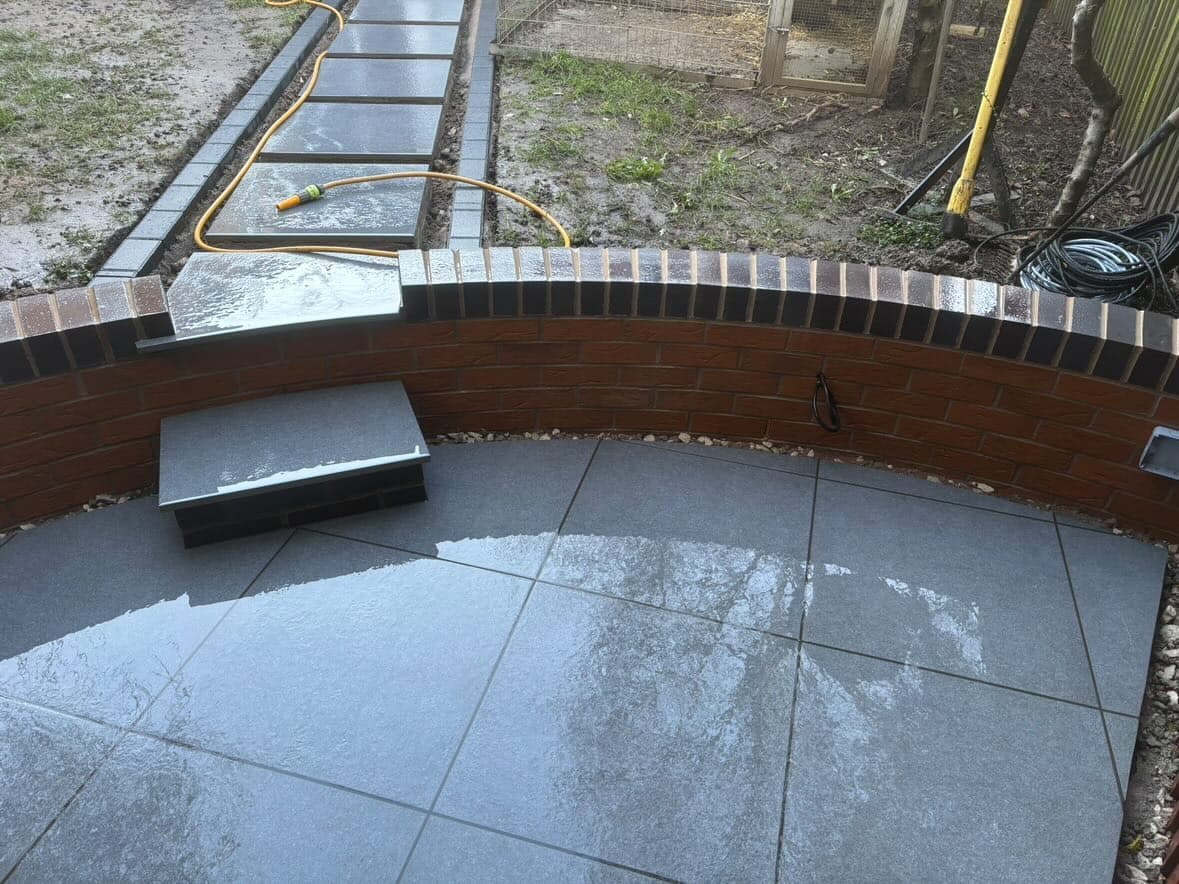
None of the above matters if the base is wrong. Porcelain goes down on exactly the build-up any good patio needs: proper excavation, a compacted MOT Type 1 sub-base laid in layers, a full wet mortar bed under every slab, and a fall of about 1 in 80 taking water away from the house.
Because porcelain slabs are thinner and completely rigid, they are less tolerant of a base that settles than a 25mm riven sandstone slab is. A void under the slab that sandstone might live with will crack porcelain. We have written up the full build-up under a patio if you want to know what should be happening under yours.
Derby ground, and what it does to a porcelain patio
Two local factors come up on nearly every job.
Clay. Much of Derby and the surrounding area sits on heavy clay that holds water rather than draining it. That makes the sub-base and the falls more important, not less, and on lower-lying plots down towards the Trent it often means a channel drain or a soakaway designed into the job.
New-build gardens. Chellaston, Boulton Moor, Mickleover and the newer estates around the city are full of gardens where the subsoil has been driven over by machinery for months and skimmed with a thin layer of topsoil. It is compacted solid, drains like a road, and needs more digging out and more base work than an established garden, not less. A quote that treats a new-build garden as the easy job has not looked at it properly.
What to ask before you accept a quote
Five questions, and the answers tell you almost everything:
1. What depth of sub-base is included, and is it compacted in layers? You want 100 to 150mm of MOT Type 1, whacked between layers. 2. Is every slab going on a full mortar bed? Not five dabs. Full bed, no voids. 3. Is the back of each slab being primed with SBR slurry? If the answer is vague, they have not laid much porcelain. 4. What fall is the patio being built to, and where is the water going? There should be a specific answer, not "it will run off". 5. What is the jointing? A proper brush-in porcelain jointing compound or a wet point. Kiln-dried sand is not pointing and will wash out.
Is porcelain the right choice for your garden?
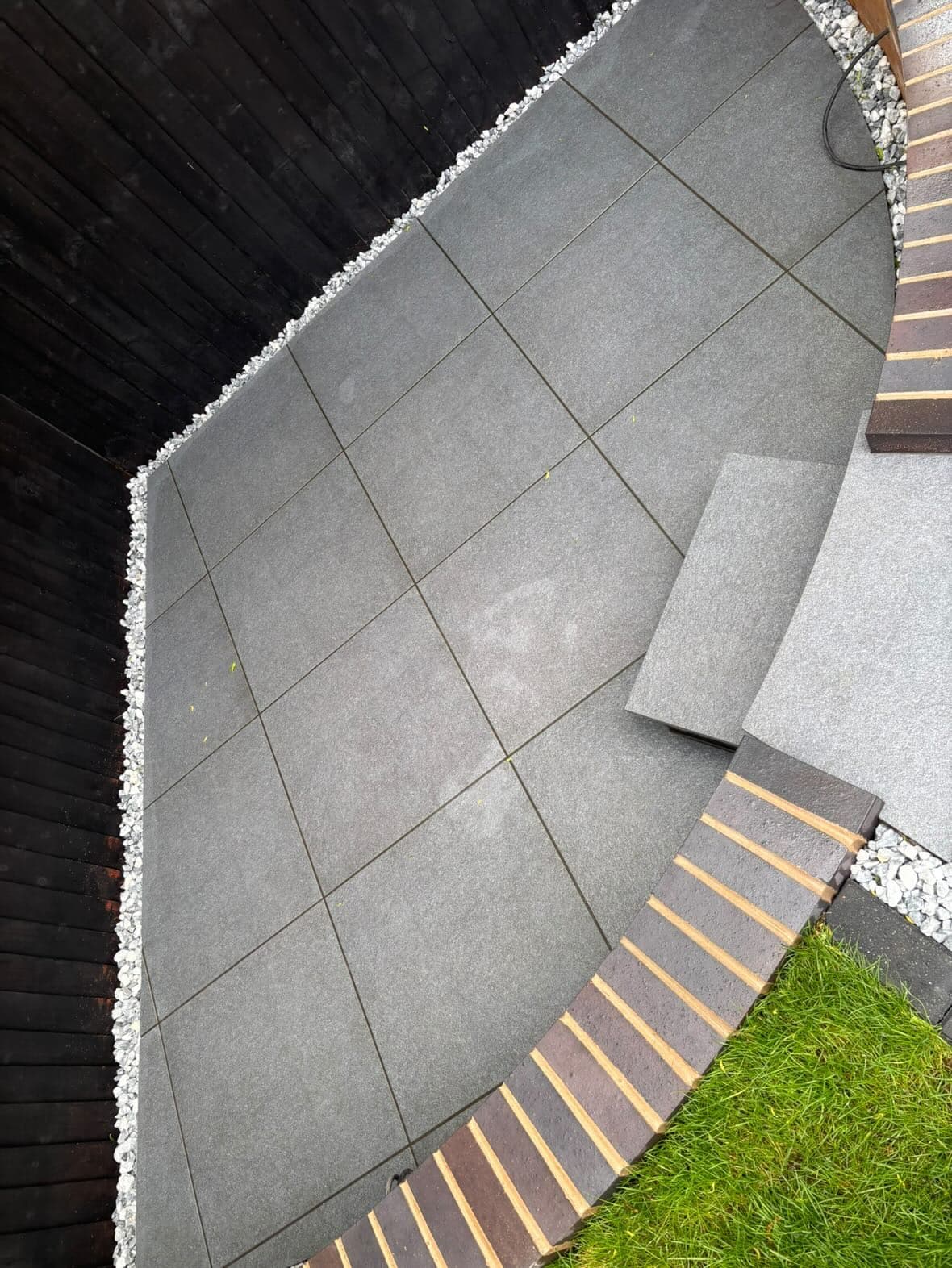
Not always. It suits modern houses, shaded gardens where sandstone would green over, and anyone who does not want to be sealing a patio every few years. On a period property with a mature garden, riven Indian sandstone usually looks more at home and costs less per square metre. We lay plenty of both, and our sandstone versus porcelain comparison sets them side by side.
The honest answer is that we will bring samples of both to the house and put them against your brickwork and your doors before you decide. A slab that looks perfect on a supplier's website often looks completely wrong in place.
Getting a porcelain patio built in Derby
We install porcelain patios across Derby, Derbyshire and the surrounding towns, and every quote itemises the groundwork so you can see exactly what is included. Have a look at our patios and paving work, or get in touch and we will come out and look at the ground first.