
The sandstone vs porcelain question comes up on almost every patio enquiry we do. Homeowners in Mickleover, Allestree, Littleover — most people planning a new patio have already started looking at both and want to know which is the better choice. There isn't a single right answer, but there's usually a better one for your particular garden.
We've installed both across hundreds of jobs in Derby and Derbyshire. Here's what we've found.
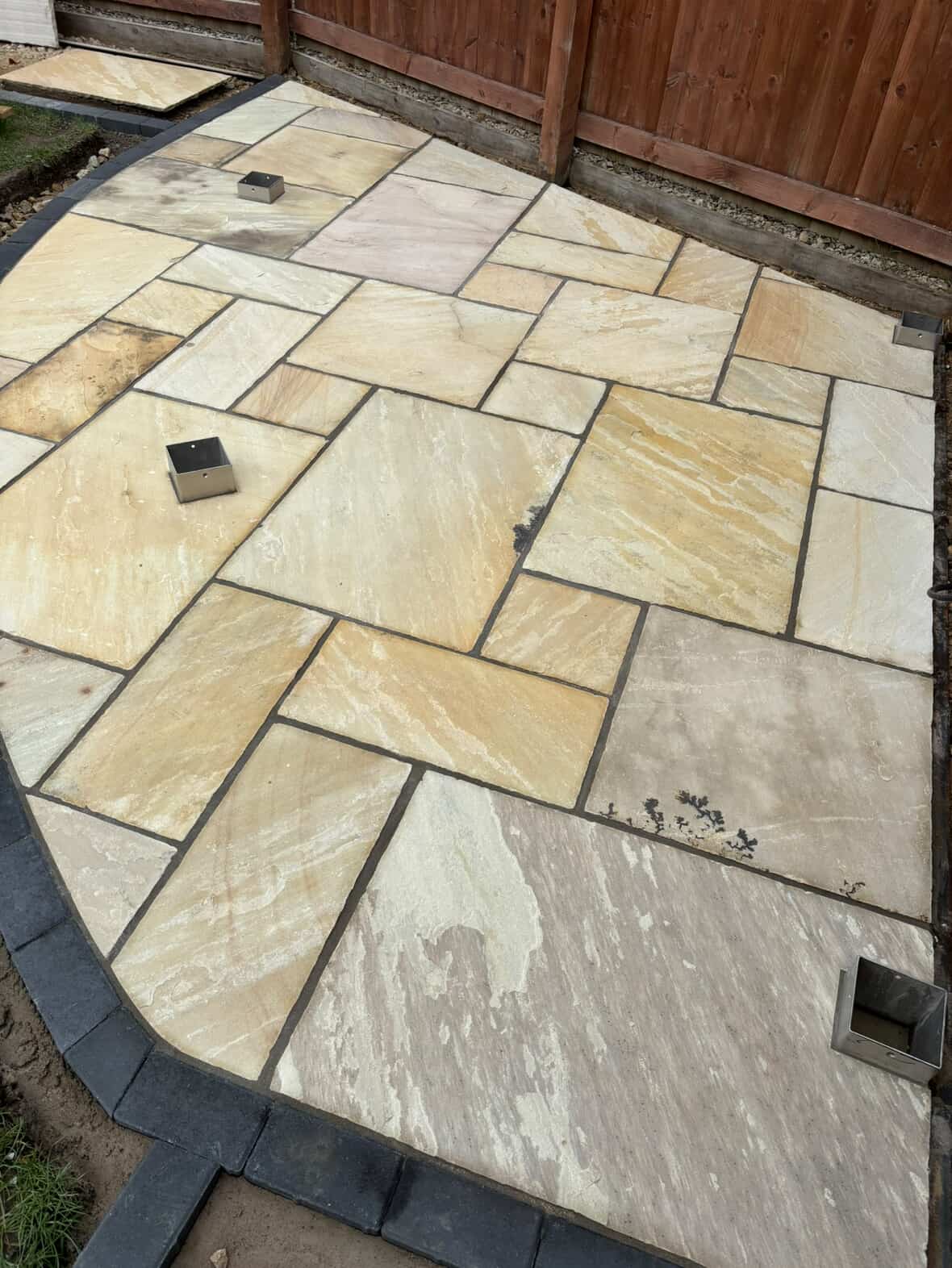
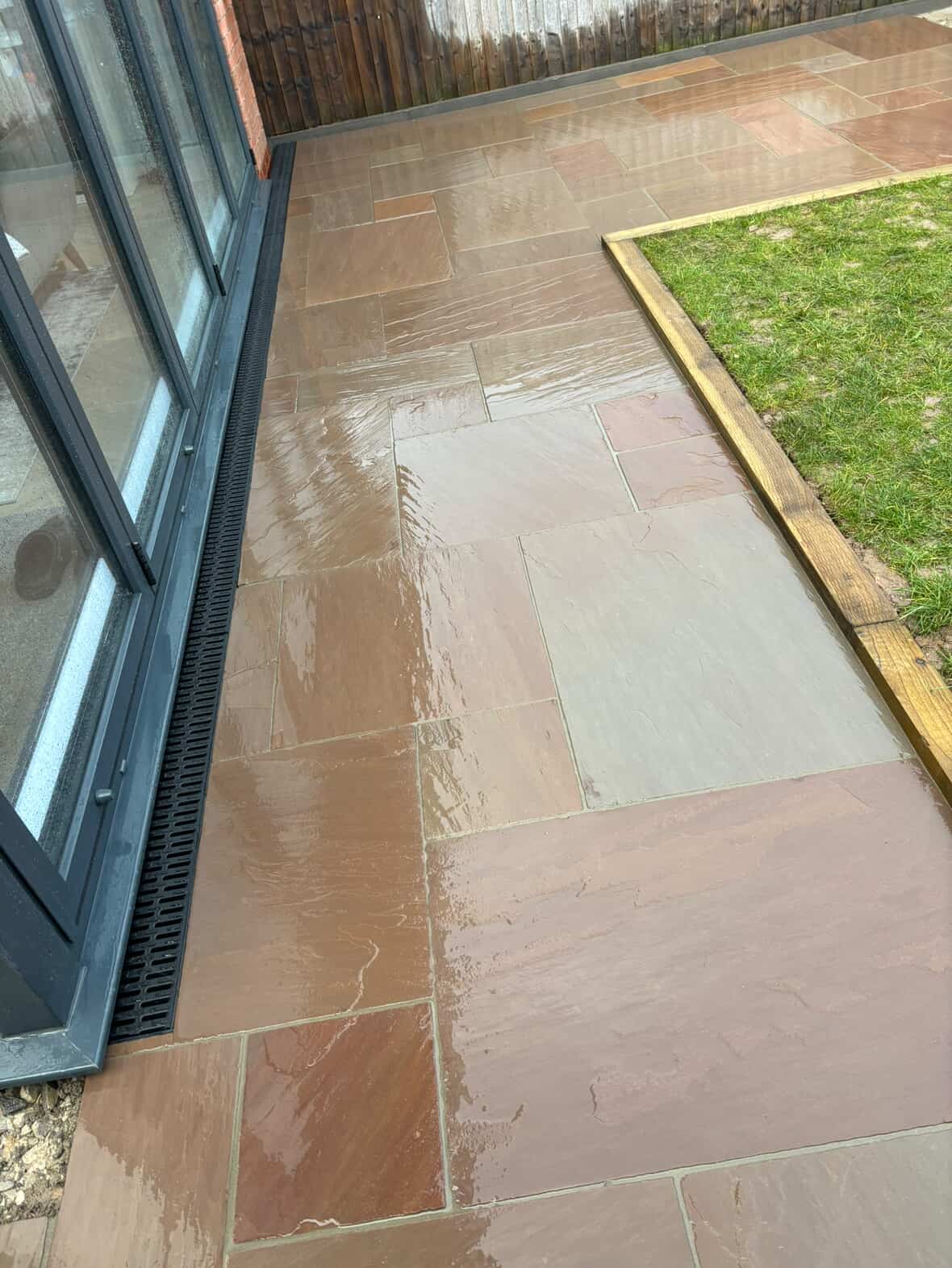
What is Indian sandstone?
Indian sandstone comes from Rajasthan, quarried from natural sedimentary rock and shipped to the UK in large volumes. It's been the default patio material here for decades.
The reason it's stayed popular is the look. No two slabs are quite the same — the tone shifts slightly across each stone, the texture is real, and the effect feels warm and organic in a way engineered materials don't quite manage. Raj Green, Buff, Autumn Brown, Camel Dust — any of these sit well against the brick tones on most Derby houses.
Properly sealed and bedded on a solid base, it lasts. Most of our sandstone jobs are still looking the part a decade or more later.
What is porcelain paving?
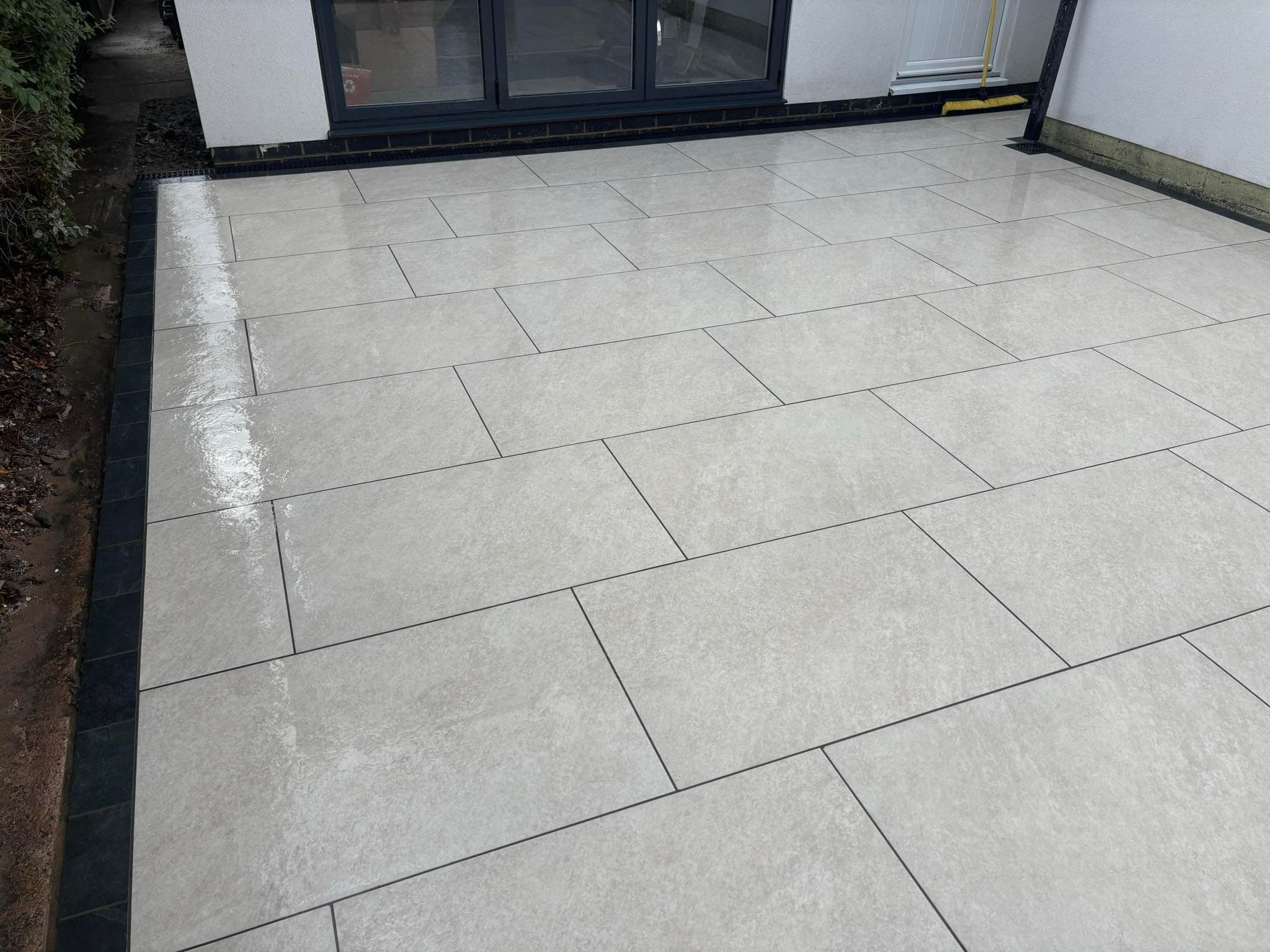
Porcelain is an engineered ceramic, pressed and fired at high temperature into an unusually hard, dense surface that barely absorbs water.
It's made to look like natural stone, concrete, or wood — but with consistent colour and texture and much lower maintenance requirements. The better ranges have improved a lot over the last five years or so. Some are genuinely difficult to tell apart from natural stone.
Appearance
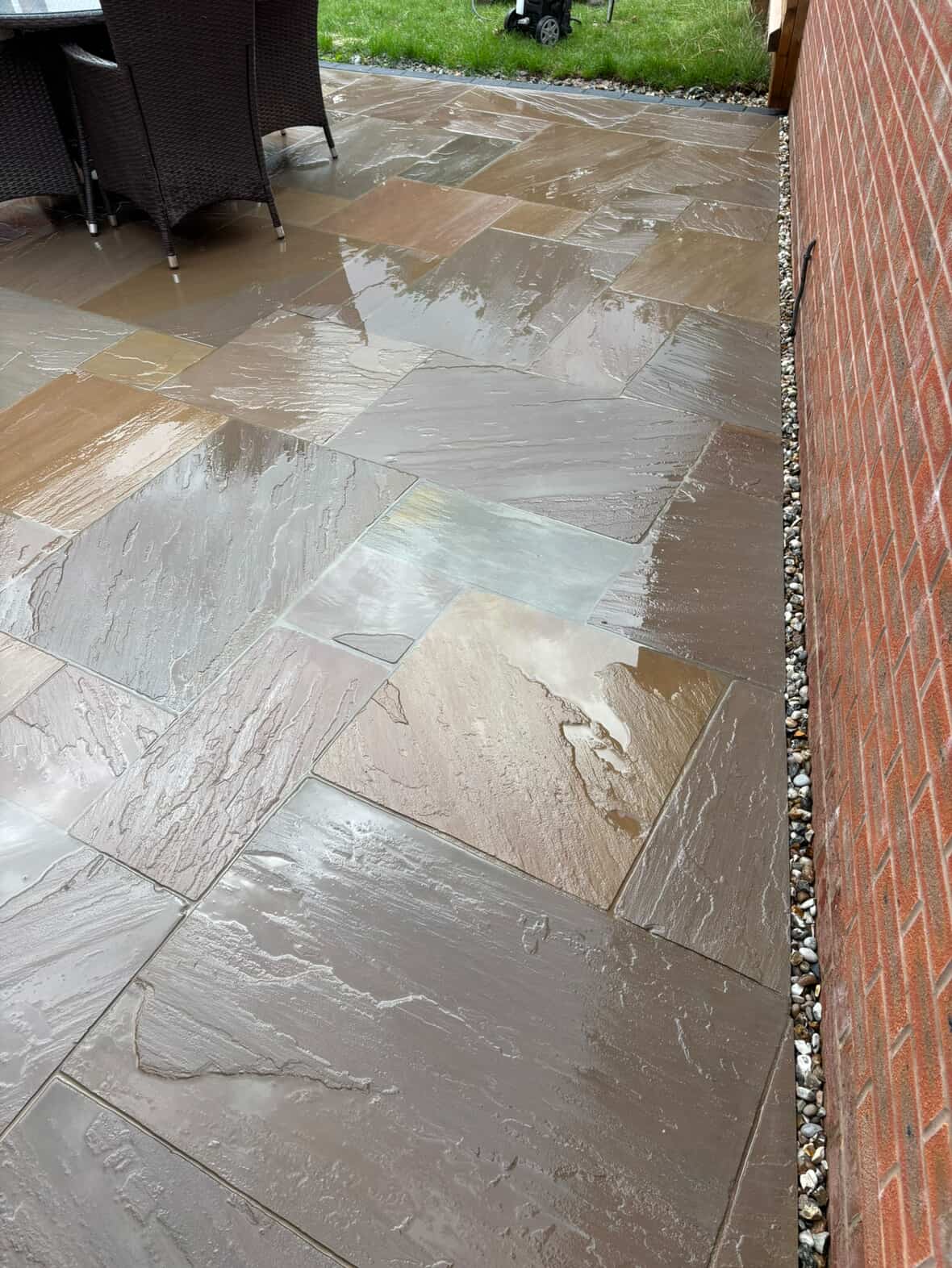
Put them next to each other and you can see the difference straight away. Which you prefer is personal.
Sandstone moves. The colour varies between slabs, the texture is real, and the overall effect feels organic. It softens a garden, sits well with planting, and often looks better after a few years than it did on day one.
Porcelain is uniform. Same colour, same texture right across the job. Sharp edges. The result is clean and contemporary — exactly right for a modern garden design. In a traditional setting, it can read as a bit flat.
Winner: Sandstone for traditional gardens, porcelain for modern.
Durability
Both cope well with normal garden use — furniture, foot traffic, the usual. Porcelain is harder and effectively impossible to scratch or chip under everyday conditions.
Where they part company is frost. Porcelain doesn't absorb water, so there's nothing to freeze and crack the surface. Sandstone is slightly porous, and without a seal it will eventually show frost damage through a Derbyshire winter. It doesn't take many frost cycles on unsealed stone before you start to see the effects.
Winner: Porcelain on durability — particularly relevant in a Derbyshire climate.
Maintenance
Porcelain barely needs any. Sweep it, pressure wash it when it needs it — that's mostly it. Leaves don't stain it, algae doesn't soak in the way it does with porous materials, and it never needs sealing. Most people just don't have to think about it.
Sandstone needs sealing every two to four years. Without it the surface picks up stains from leaves, algae, and spills. Sealing it yourself takes a Saturday afternoon and the right product — not difficult, but you do actually have to do it. If you're already thinking "I probably won't get around to that," factor it in now.
Winner: Porcelain.
Installation
Porcelain is a more demanding install. It needs a flat, well-prepared concrete base — the tolerances are tight and an uneven substrate shows. Cutting requires diamond-tipped blades; a standard angle grinder chips the edges. Get it right and it looks excellent. Get it wrong and it's very obvious.
Sandstone is more forgiving. A sand-and-cement mortar bed is standard, it tolerates minor variations in the base, and it cuts faster and more easily. Part of why it costs less.
Most decent patio contractors can handle both. But when getting quotes, ask specifically about porcelain experience. There are contractors who are perfectly competent with sandstone but haven't done enough porcelain to install it consistently well.
Winner: Sandstone.
Cost
Indian sandstone in Derby typically comes in at £80–£110 per m² installed — material and labour included. Porcelain tends to run £100–£140 per m², depending on the tile spec and what the base preparation requires.
On a 30m² patio, that's potentially £600–£900 more for porcelain at the lower end. A real difference for most budgets.
The counterpoint is that porcelain costs less to maintain over time — no sealant, less cleaning. Over fifteen years the gap narrows, though it doesn't close completely.
Winner: Sandstone on upfront cost. Porcelain may come close over the longer term.
Suitability for Derby and Derbyshire
Both materials work well in the local climate. Derby gets moderate rainfall and cold winters with regular frosts — normal for the East Midlands, but worth factoring in when choosing materials.
North-facing gardens that stay shaded and damp through winter suit porcelain better. An unsealed or undersealed sandstone patio in that kind of setting will develop algae and become slippery. Properly sealed sandstone handles Derbyshire winters fine, but the upkeep matters more in those conditions.
Summary table
| Indian Sandstone | Porcelain | |
|---|---|---|
| Look | Natural, varied, warm | Consistent, sleek, modern |
| Durability | Very good | Excellent |
| Maintenance | Seal every 2–4 years | Low — sweep and wash |
| Frost resistance | Good (when sealed) | Excellent |
| Installation | Straightforward | More complex, concrete base |
| Cost | £80–£110/m² installed | £100–£140/m² installed |
| Best for | Traditional or mixed styles | Modern gardens, low maintenance |
So which should you choose?
Go with sandstone if you want a material that feels natural, looks better with age, and you're working to a tighter budget — provided you're honest with yourself about keeping up with sealing it every couple of years.
Go with porcelain if low maintenance is a real priority (kids, dogs, a schedule that doesn't stretch to a sealing afternoon), you want a clean contemporary look, or the garden is shaded and stays damp through winter.
After 20-odd years of laying both, most homeowners who go with sandstone are happy they did. Same goes for porcelain. It usually comes down to budget and a realistic answer to how much maintenance you'll actually do.
Still not sure? Come and look at some of our completed jobs in Derby. Seeing both materials in a real garden in actual Derbyshire light tends to sort it out faster than reading about them online.
Get a free quote from MIW
We install Indian sandstone and porcelain patios across Derby, Mickleover, Littleover, Allestree, Long Eaton, and throughout Derbyshire. Every quote is free, no obligation.
Get a Free Quote → or call Jamie on 07891 632305.