
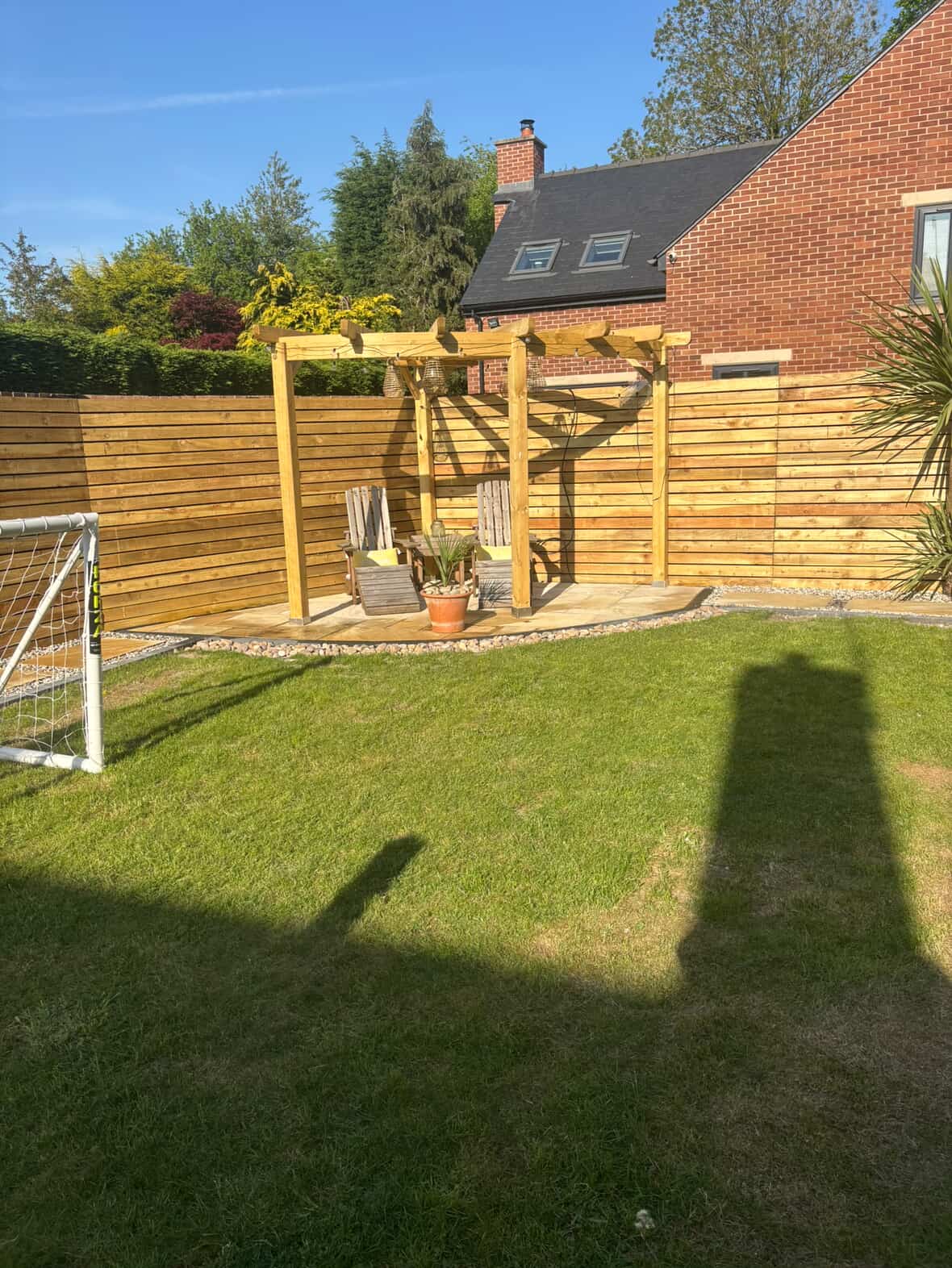
Fencing is one of those jobs people put off until a winter storm makes the decision for them. Then it becomes urgent, the quotes come in at wildly different prices, and the choice between composite and timber has to be made in a hurry.
It is worth thinking about before that happens. Here is a straight comparison from a team that fits both and has no stake in which one you pick. If you would rather just get a figure for your own boundary, our fencing page explains how we build them and you can ask for a quote in a couple of minutes.
The quick answer
For most Derby gardens, treated timber remains the sensible choice on cost, and looks superb for the first few years. Composite wins outright if you never want to pick up a brush again, and it is the better long-term buy if you are staying put.
But the material is genuinely the second most important decision. The first is what holds it up.
What actually fails on a fence
Almost every fence we are called out to replace has failed in the same place: the bottom of the post, at ground level, where wet soil meets timber.
The panels are usually fine. The rails are usually fine. The post has rotted through, or it was driven into the ground rather than concreted and has slowly worked loose through a few windy winters until the whole run leans.
This matters because it changes how you should read a quote. A cheap fence in expensive composite is still a cheap fence. If two prices are far apart, the difference is very often below ground:
- Concrete posts, set in concrete. The base of a timber post is the weak point, so removing timber from that zone entirely is the single biggest thing you can do for longevity.
- Concrete gravel boards. These keep the bottom of the panel clear of wet ground and soil splash. They also mean a damaged board can be swapped without touching the panel.
- Dug holes, not driven posts. Driving a post in is quicker and cheaper. It is also why so many fences in Derby lean after five years.
Get those three right and a mid-range timber fence will outlast a premium composite one fitted badly.
Cost
Rough figures for a typical Derby garden boundary, supplied and fitted:
| Treated timber | Composite | |
|---|---|---|
| Up-front cost | Lower | Roughly double |
| Re-treating | Every 2 to 3 years | Never |
| Realistic lifespan | 10 to 15 years | 20 to 25 years |
| Repairs | Cheap, boards easily replaced | Dearer, system-specific parts |
Over a twenty year window the two land closer together than the initial quotes suggest, because the timber fence needs replacing once inside that period and treating perhaps eight times. Over a five year window, timber is clearly cheaper and it is not close.
That is really the whole decision. How long are you staying?
Upkeep
Timber needs re-treating every two to three years to hold its colour and resist rot. That is a weekend job with a sprayer for a typical garden, and it is genuinely not onerous, but it does need doing and most people let it slide. Once softwood has silvered off and started to crack, staining it will improve the colour but will not undo the weathering.
Composite needs washing down occasionally and nothing else. No stain, no preservative, no cracking, no splinters. For rented properties, holiday lets, or anyone who would simply rather not think about it, that is worth paying for.
Looks
This is more personal than people expect, so it is worth seeing both in the flesh rather than online.
Timber looks warmer and has genuine grain variation. New treated softwood in the sun is lovely, and horizontal slatted timber in particular has become the most requested style we fit around Derby. It suits modern housing, reads as a clean architectural line rather than a stack of panels, and makes a narrow garden feel wider.
Composite is more uniform. That consistency is exactly what some people want and exactly what puts others off. It holds its colour, but it will never have the character of real wood.
Sloping gardens
Plenty of Derbyshire gardens are not flat, and a fence on a slope is built one of two ways:
- Stepped, where each panel sits level and the tops form a staircase down the gradient. This suits most gardens, looks tidy, and works with standard panels.
- Raked, where the panels follow the slope so the top line runs parallel with the ground. It looks seamless but needs bespoke panels, which costs more and rules out some composite systems.
Composite is generally less forgiving here. If your boundary drops significantly, mention it early, because it can narrow the options before you have even chosen a colour.
So which should you choose?
Ask yourself three questions:
1. How long are you staying? More than ten years tilts it to composite. Less, and timber is the better use of the money. 2. Will you actually maintain it? Be honest. If the answer is no, composite is not an indulgence, it is the cheaper option in practice. 3. Is the garden exposed? If so, prioritise a slatted design and proper concreted posts over the material choice entirely.
We fit both and genuinely have no preference, so ask us what we would put in our own garden and you will get a straight answer rather than whichever carries the better margin. Have a look at how we build them, or send us a photo of the boundary and we will come and price it properly.