
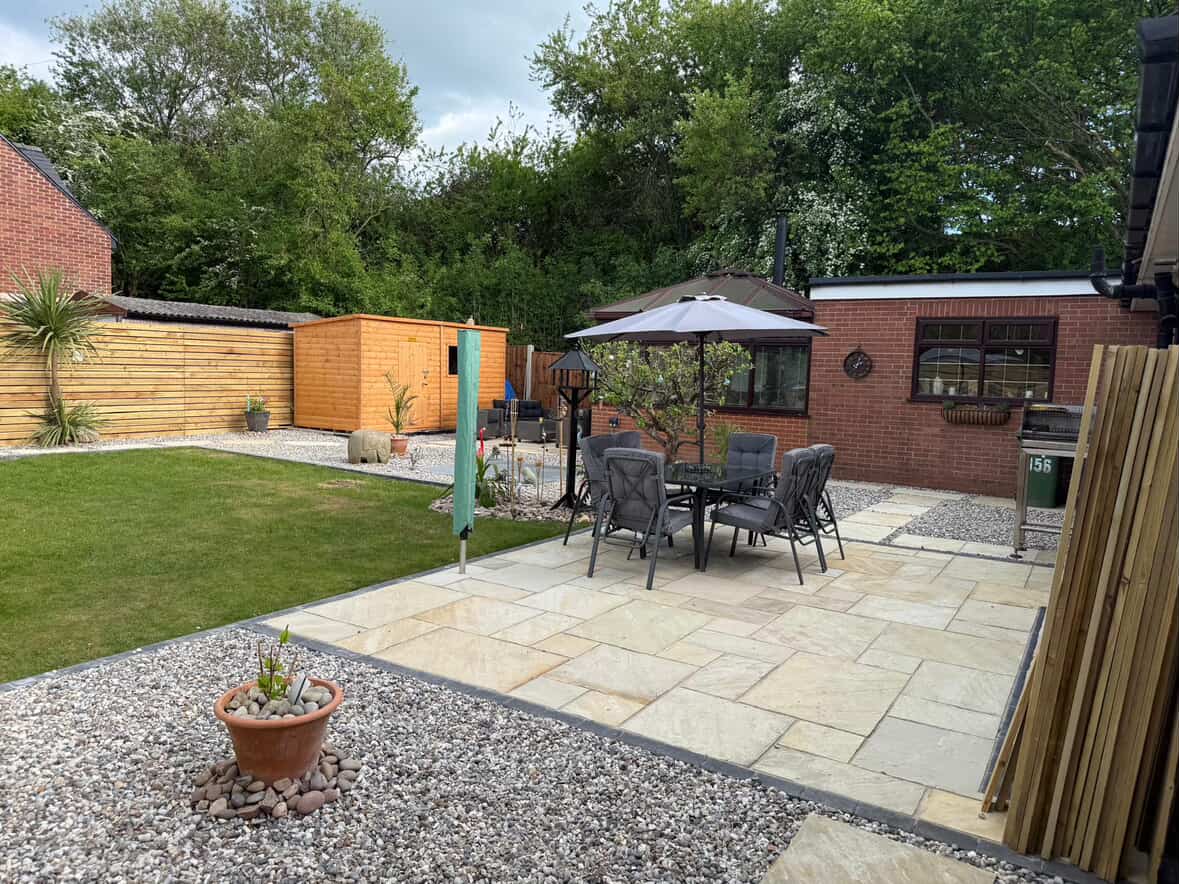
It is one of the most common questions we get in Derby: should I go for a patio or decking? Both give you a proper outdoor surface to sit, dine and relax on, and both can look fantastic. But they behave very differently over the years, and the right answer depends on your garden, your budget and how much upkeep you are willing to do.
Here is an honest, side-by-side look at how the two compare, from a team that installs both. If you would rather just get a figure for your own garden, send us a few details and we will quote it for free.
The quick answer
For most Derby gardens, a patio is the lower-hassle, longer-lasting choice, and usually the cheaper one over its lifetime. Decking comes into its own on sloping plots, raised areas, and where you want that warmer, softer, timber feel underfoot.
Neither is simply "better". They are different tools for different jobs, so it is worth weighing them up properly before you commit.
Cost
A patio and softwood decking can land in a similar range to install on a straightforward, flat garden. The difference shows up later. Timber needs cleaning and re-treating every year or two, and softwood boards eventually rot and need replacing. A patio, once it is down, costs almost nothing to keep.
Composite decking removes most of that maintenance but costs noticeably more upfront, typically more than an equivalent patio. So the ranking usually looks like this over the full lifespan:
- Cheapest long term: a well-laid patio
- Middle: composite decking
- Cheapest to install but dearest to own: softwood decking
For real per-m² patio figures, our guide on how much a patio costs in Derby breaks it down properly.
Maintenance
This is where paving pulls ahead for a lot of people. A patio needs an occasional wash and, for natural stone, a re-seal every few years. That is it.
Decking asks for more: a proper clean to shift algae, a fresh coat of treatment or oil on timber, and a check for loose or lifting boards. Skip it for a couple of seasons and timber decking goes grey, green and slippery. Composite is far more forgiving but still benefits from a wash to stop it getting slick in shade.
Lifespan
A patio laid on a compacted sub-base with the right fall will comfortably see 25 years and often a good deal more. Softwood decking is more like 10 to 15 before boards start failing; composite lands around 25 to 30.
If you want to do the job once and forget about it, paving is the safer bet.
Slopes and levels
Decking has one clear advantage: it can be raised on posts to float over a slope or a drop without the excavation, retaining walls and imported hardcore a patio would need on the same ground. On a steeply sloping Derby garden, that can make decking both quicker and cheaper.
On flat or gently sloping plots, though, a patio with a step or two is usually the better long-term surface. If your garden has awkward levels, our garden makeovers service is built exactly for that kind of problem.
Safety and grip
Modern porcelain and textured natural stone hold their grip well when wet. Timber decking can get slippery with algae if it is not kept on top of, especially in shade, which is worth thinking about if you have young children or older relatives using the garden. Grooved and composite boards help, but paving generally needs less thought here.
The best of both
You do not always have to choose. Plenty of the gardens we build in Derby combine the two: a patio dining area next to the house where it stays clean and dry, and a raised deck further down to catch the last of the sun or level off a difficult corner. Splitting a garden into zones like this makes it feel bigger and gives you more ways to actually use the space.
So which should you choose?
Lean towards a patio if you want the lowest upkeep, the longest life, and the best return if you ever sell. Lean towards decking if you are working with a slope or a raised area, or you simply love the look and feel of timber and do not mind the maintenance.
Still not sure? That is exactly what we are here for. We will come and look at your garden, talk through the levels and how you want to use the space, and give you a straight recommendation with no pressure. Get in touch to book a free visit.